
If you're planning your garden for summer and you've started looking at festoon lights, you've probably already hit the same question that stumps most UK buyers: solar or mains? They look almost identical strung up across a patio or pergola, but under the surface they behave very differently — and choosing the wrong one for your situation can mean disappointment by October.
This guide covers everything you need to know about solar vs mains festoon lights in the UK: how each type works, how our unpredictable climate affects performance, a straight head-to-head comparison, and a clear decision framework so you can buy with confidence.
1. What Are Solar Festoon Lights?
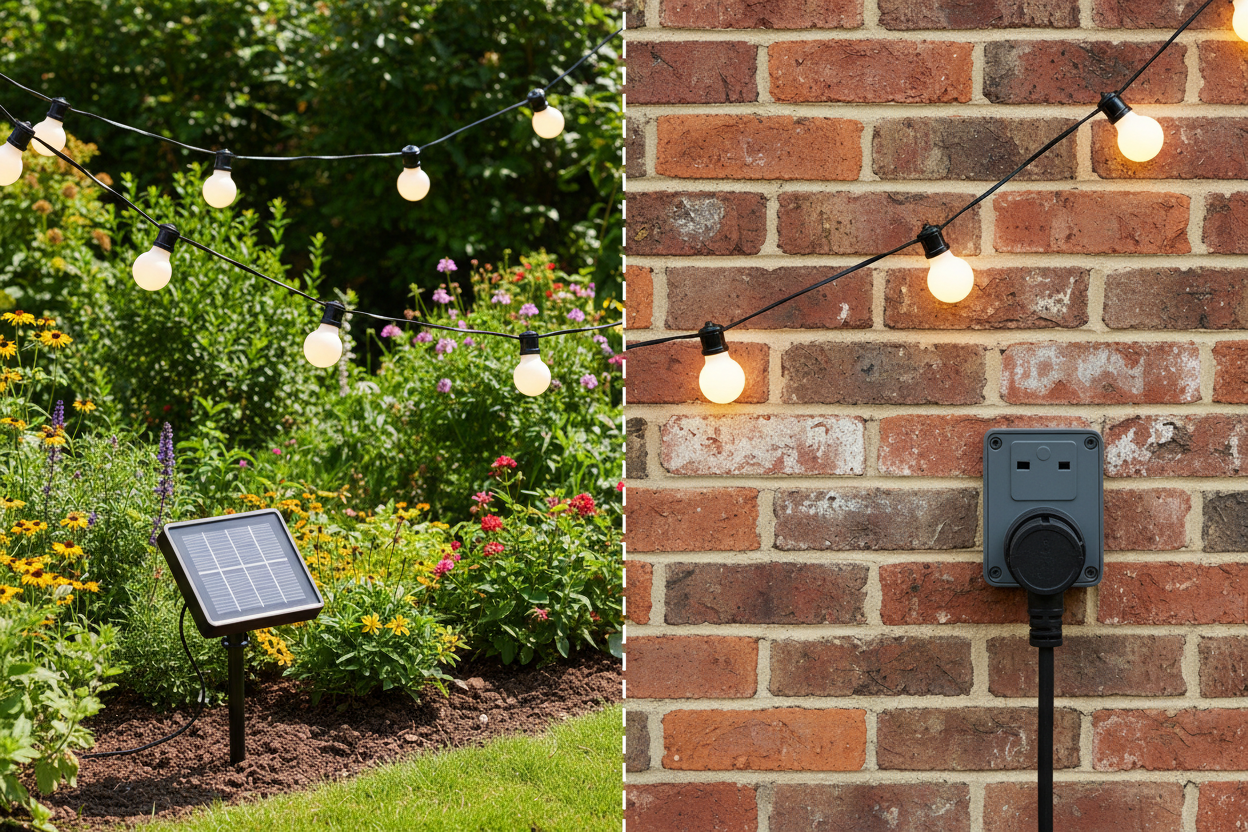
Solar festoon lights are self-contained lighting systems powered entirely by the sun. A small solar panel — usually staked into the ground nearby — absorbs sunlight during the day and stores that energy in a built-in rechargeable battery. Once it gets dark, the lights switch on automatically and run off that stored charge.
A typical solar festoon string includes a panel of around 2–4 watts, a battery capacity of 1,200–2,000mAh, and anywhere from 10 to 25 bulbs. On a full charge, most strings offer 6–10 hours of illumination.
Solar festoon lights are ideal for anyone without an outdoor power socket, renters who can't make permanent changes to the property, or buyers who want a zero-running-cost, eco-friendly option for summer evenings.
Browse our Solar Lights collection
2. What Are Mains Festoon Lights?
Mains festoon lights plug into a standard outdoor socket or a weatherproof extension lead. Power is constant, the brightness never wavers, and you don't have to think about weather or battery levels — plug in, switch on, done.
Typical specs include IP44 to IP65 weather ratings, cable lengths from 5m up to 25m+, and connectable designs that allow multiple strings to be joined end-to-end. LED bulbs mean the running costs are minimal despite the consistent power draw.
Mains festoon lights are best suited to permanent garden setups, large outdoor spaces such as pergolas and long fence runs, and anyone who needs reliable performance from spring through to the Christmas period.
Browse our LED Festoon & String Lights collection
3. How the UK Climate Affects Your Choice
This is the section most buying guides skip — and it's arguably the most important consideration for UK buyers.
The question we get asked most is: do solar festoon lights actually work in the UK? The honest answer is yes, but with real limitations outside of summer.
From May to September, solar festoon lights perform well in the UK. Days are long, sunlight is reasonably consistent, and a full day's charge will typically deliver 6–8 hours of light through the evening. This covers most garden entertaining and outdoor dining situations perfectly.
From October through to March, the picture changes. Daylight hours drop significantly, cloud cover is frequent, and solar panels simply don't receive enough direct sunlight to charge fully. The result is dimmer output, shorter run times, and some evenings where the lights barely last past 9pm. This isn't a flaw — it's just physics.
Mains festoon lights are completely unaffected by weather or season. They perform identically in January as they do in July.
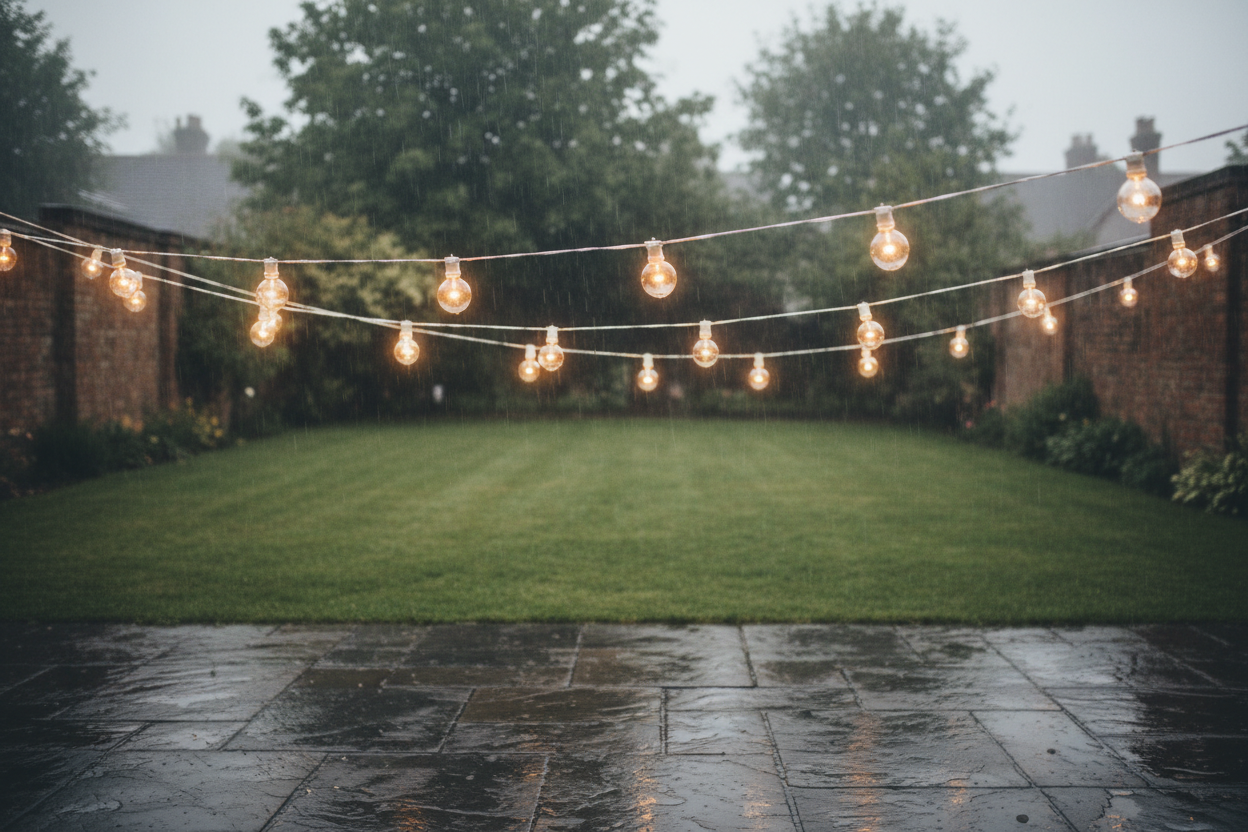
One thing both types share: for permanent UK outdoor use, always look for a minimum IP44 rating, and ideally IP65 if the lights will be left out year-round. The UK's rain and damp conditions make this non-negotiable.
4. Head-to-Head Comparison
Brightness
Mains festoon lights are consistently brighter. Solar lights can match them on a well-charged summer evening, but output drops as battery levels fall during the night or after overcast days.
Reliability
Mains lights switch on every time without fail. Solar lights may dim or cut out earlier than expected after cloudy periods, particularly in autumn and winter.
Installation
Solar is far simpler — stake the panel in a sunny spot, hang the lights, and you're done. No outdoor socket, no wiring, no electrician needed. Mains lights require access to an outdoor socket or a weatherproof extension lead, and you'll need to think about safe cable routing.
Running Costs
Solar costs nothing to run once purchased. Mains LED festoon lights are very cheap to run — a typical 10W LED string costs approximately 1–2 pence per night at current UK electricity rates, so even year-round use adds very little to your bill.
Flexibility and Portability
Solar wins clearly here. You can move solar lights to a different part of the garden, take them to a camping trip, or reposition them as your garden changes. Mains lights are more fixed once cables are routed.
Length and Scalability
Mains lights offer significantly more flexibility for larger spaces. Many systems are connectable — you can join multiple strings together to run the full length of a fence, pergola, or terrace. Solar strings are standalone: one panel powers one string, and you can't connect them together.
Lifespan and Durability
Both types are broadly similar in lifespan when bought from a quality supplier. One note: solar panels degrade slightly over several years, which can reduce charging efficiency over time. Mains lights tend to offer more consistent long-term performance.
5. Solar Festoon Lights: Pros and Cons
Pros:
- Zero electricity cost once purchased
- No outdoor socket or wiring needed
- Easy to install and move around
- Eco-friendly and energy-independent
- Great for renters or temporary setups
Cons:
- Performance drops in low light and winter months
- Shorter run times after cloudy days
- Generally less bright than mains equivalents
- Each panel powers one string only — not scalable
6. Mains Festoon Lights: Pros and Cons
Pros:
- Consistent brightness regardless of weather or season
- Works reliably from March through to December (and beyond)
- Connectable systems for larger coverage areas
- Switches on every time without fail
- Very low running costs with LED bulbs
Cons:
- Requires an outdoor socket or weatherproof extension lead
- Small ongoing electricity cost
- Less portable — cables need careful routing
- More involved installation
7. Which Is Better for Your Situation?
Choose Solar Festoon Lights If…
- You don't have an outdoor power socket
- You rent your property and can't make permanent changes
- You want lights primarily for summer evenings (May to September)
- You're lighting a small patio, balcony, or seating area
- Eco-friendliness and zero running costs are a priority for you
Choose Mains Festoon Lights If…
- You want lights that work reliably from spring through to winter
- You're covering a large garden, pergola, long fence run, or terrace
- You want to connect multiple strings together for a seamless look
- You're using them for a specific event where failure isn't an option
- You already have an outdoor socket or are happy to have one installed
The Middle Ground
A number of our customers use both — solar strings as accent lighting around a seating area or along a path, with a mains string as the primary overhead lighting. It's a practical hybrid approach that gives you the flexibility of solar where it matters and the reliability of mains where you need it most.
8. What to Look for When Buying Either Type
IP Rating: For UK outdoor use, IP44 is the minimum — it handles rain and splashes. IP65 is the better choice for lights that stay outdoors permanently through winter. Both ratings are clearly listed on product pages.
Bulb Shape: S14, ST64, and G40 bulbs all look slightly different. S14 gives a classic elongated filament look; G40 is a rounder globe shape. Neither is better — it's a style preference.
Cable Material: Rubber-coated cables outlast PVC cables in outdoor UK conditions. Worth checking if you're buying for a permanent setup.
Connectable Systems: If you're buying mains lights for a large space, check whether the product supports end-to-end connection. Not all strings do.
Warranty and Returns: Check the supplier's returns policy before buying, particularly for solar products — battery performance in the first few months will tell you a lot about the product's long-term quality.
9. Frequently Asked Questions
Do solar festoon lights work in the UK? Yes, but with limitations. They work well from May to September when daylight hours are long. In autumn and winter, shorter days and frequent cloud cover reduce charging time, which leads to dimmer output and shorter run times.
Can I leave festoon lights out all year in the UK? Yes, provided they carry an IP65 rating. IP44 is suitable for occasional rain but isn't recommended for permanent outdoor exposure through the UK winter.
How long do solar festoon lights stay on? Typically 6–10 hours after a full charge in summer conditions. In autumn and winter, expect shorter run times of 3–5 hours depending on how much sunlight the panel received during the day.
Are mains festoon lights expensive to run? No. LED festoon lights use very little electricity — usually 1–2 pence per night for a standard string. Even running them every night through summer adds up to just a pound or two over the season.
Can you connect solar festoon lights together? In most cases, no. Each solar panel is designed to power one string only. If you need to cover a large space, mains connectable festoon lights are the better option.
10. Conclusion
The decision comes down to one question: how and when do you want to use them?
Solar festoon lights are the right choice for flexible, fuss-free summer lighting — perfect for patios, balconies, and anyone without an outdoor socket. Mains festoon lights are the better investment if you want reliable, year-round performance across a larger space.
If you're ready to choose, explore our full range below:
- Solar Lights — ideal for summer, no socket needed
- LED Festoon & String Lights — reliable, connectable, year-round
- Outdoor Garden Lights — browse the full outdoor lighting range
- All Festoon Lights — see everything in one place